




Concrete Hardscape Installation in Austin, TX: Structural Specification Standards
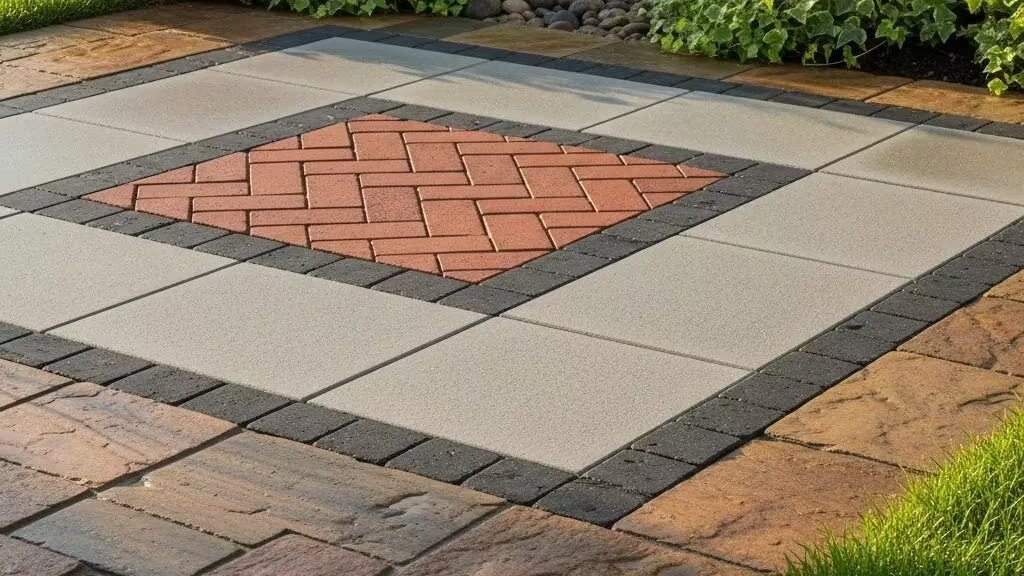
Are you planning a poured concrete patio, walkway, or structural slab for your Austin property and trying to understand what separates a properly specified concrete installation from the production pours that look acceptable on completion day but crack, heave, or fail within the first few seasons on our region's expansive clay soil? Concrete hardscape construction is a category where mix design, reinforcement specification, and control joint placement, decisions made before a single yard of concrete is poured, determine whether the finished slab performs for decades or develops visible problems within the first year or two.
At Doddridge Landscaping, structural concrete installation is part of our hardscape services across Austin. Here is what proper specification actually involves.
Base Preparation and Soil Considerations
As Blog 3 establishes for paver base construction, Austin's expansive clay soil requires the same attention to subgrade preparation for poured concrete applications, with excavation and compaction specifications accounting for clay's seasonal expansion and contraction, since concrete poured over an inadequately prepared clay subgrade experiences the differential movement that produces cracking regardless of concrete mix quality.
Base course specification beneath structural concrete slabs uses four to six inches of compacted crushed aggregate, providing a stable, well-draining layer between the clay subgrade and the concrete slab, reducing the direct soil movement transmitted to the slab above.
Concrete Mix Specification
Compressive strength specification for residential patio and walkway applications typically calls for a minimum 3,000 to 3,500 PSI mix, while driveway or vehicle-bearing applications typically specify 4,000 PSI or higher given the increased load demand these surfaces experience.
Air entrainment specification incorporates a controlled percentage of air entrainment additive into the concrete mix, improving freeze-thaw durability for the occasional hard freeze events Austin experiences, along with improving overall workability during placement.
Reinforcement Specification
Rebar specification for structural slabs uses appropriately sized and spaced steel reinforcement, commonly number three or four rebar on a grid pattern spaced 18 to 24 inches depending on slab thickness and application, providing tensile strength the concrete itself lacks and helping control crack width if cracking does occur.
Welded wire mesh specification, an alternative to rebar for lighter-duty residential applications, requires proper positioning within the slab's middle third during the pour, since mesh that settles to the bottom of the slab during placement, a common installation error, provides essentially no reinforcement benefit at all.
Slab thickness specification typically calls for a minimum four-inch thickness for standard patio and walkway applications, increasing to five or six inches for driveway or vehicle-bearing applications, sized according to expected load and the subgrade conditions established during site assessment.
Control Joint Specification
Control joint spacing specification follows a general rule of 24 to 36 times the slab thickness in inches, meaning a four-inch slab typically specifies control joints every eight to twelve feet, directing the inevitable shrinkage cracking that occurs as concrete cures into these designed joint locations rather than allowing random, unsightly cracking across the slab's visible surface.
Joint depth specification cuts to approximately one-quarter of the slab's total thickness, timed within the first 24 hours after the pour while the concrete is still able to be cut cleanly without excessive raveling at the joint edges.
Finishing and Curing Specification
Surface finish specification, broom finish, exposed aggregate, or stamped decorative finish, affects both slip resistance and appearance, with finish selection and timing during the concrete's plastic state determining how successfully the intended texture or pattern is achieved.
Curing specification maintains adequate moisture in the concrete for a minimum seven days after placement, either through curing compound application or moisture retention methods, since concrete that dries too quickly during the curing period achieves significantly lower ultimate strength than properly cured concrete using the identical mix design.
What Concrete Hardscape Installation Costs
Standard poured concrete patios and walkways, including proper base preparation and reinforcement, typically cost 10 to 18 dollars per square foot depending on finish selection. Stamped or decorative concrete finishes, requiring additional labor and specialized finishing technique, typically run 16 to 26 dollars per square foot.
Why Reinforcement and Joint Placement Determine Longevity
Concrete slabs installed with proper subgrade preparation, adequate reinforcement, and correctly spaced control joints typically perform for 25 to 30 years or more with minimal visible cracking. Slabs poured without adequate reinforcement or with improperly spaced control joints frequently develop random, unsightly cracking within the first few years as Austin's clay soil movement and normal concrete shrinkage find the path of least resistance across an under-specified slab.
The team at Doddridge Landscaping installs structural concrete across Austin with the base preparation, reinforcement, and joint specification our region's soil conditions genuinely require.

Planning a concrete patio, walkway, or slab for your Austin property? Reach out to Doddridge Landscaping today.
.svg)
.svg)
.svg)

.svg)