




Sod Installation in Austin, TX: Soil Preparation and Cultivar Specification Standards
Are you planning sod installation on your Austin property and trying to understand what separates a properly prepared installation from the production sod jobs that look green on delivery day but thin, yellow, or fail entirely within the first season on our region's clay soil and summer heat? Sod installation in Austin is a category where soil preparation quality and cultivar selection accuracy determine whether the finished lawn establishes into genuinely healthy, long-term turf or struggles from week one against conditions the installation never actually addressed.
At Doddridge Landscaping, sod installation is part of our sod installation service across Austin. Here is what proper installation actually involves.
Site Assessment and Cultivar Selection
Sun exposure mapping across the installation area determines cultivar selection zone by zone, since a single uniform sod variety installed across a property with significant sun and shade variation predictably underperforms in whichever zone doesn't match that cultivar's light requirements.
Bermuda cultivar specification, Tifway 419 and Celebration among the most common commercial-grade cultivars used in Central Texas, requires full sun exposure of six or more hours daily and performs well under heavy foot traffic and Austin's heat, but declines significantly in shaded zones.
St. Augustine cultivar specification, Palmetto and Raleigh varieties most common regionally, tolerates partial shade meaningfully better than Bermuda, requiring roughly four hours of direct sun, but demands more consistent irrigation and shows less foot traffic tolerance.
Zoysia cultivar specification, Zeon and El Toro varieties, offers a middle ground between Bermuda's sun and traffic tolerance and St. Augustine's shade tolerance, along with generally lower mowing frequency requirements, though establishment is typically slower than either alternative.
Soil Preparation Standards
Soil testing before installation determines existing pH, compaction level, and organic content, since Austin's clay soil frequently requires amendment beyond simple tilling to provide the aeration and drainage new sod roots need to establish successfully.
Grading specification establishes a minimum quarter-inch per foot slope away from structures across the sod area, corrected before any soil amendment or sod placement, since grading corrections after sod installation require full removal and reinstallation.
Soil amendment specification incorporates compost or expanded shale into the top four to six inches of native clay soil, improving aeration and drainage capacity specifically in the root zone where new sod needs to establish, rather than leaving compacted, poorly draining clay directly beneath the new sod layer.
Tilling depth specification reaches a minimum of four to six inches, breaking up compaction from prior construction activity or existing turf removal, with a final rake pass removing debris and establishing a smooth, consistent surface before sod delivery.
Installation Sequence
Sod delivery timing coordinates with installation to minimize the time sod spends stacked on pallets, since sod left stacked for more than 24 to 48 hours, particularly in Austin summer heat, begins to heat internally and can suffer significant quality degradation before it's ever installed.
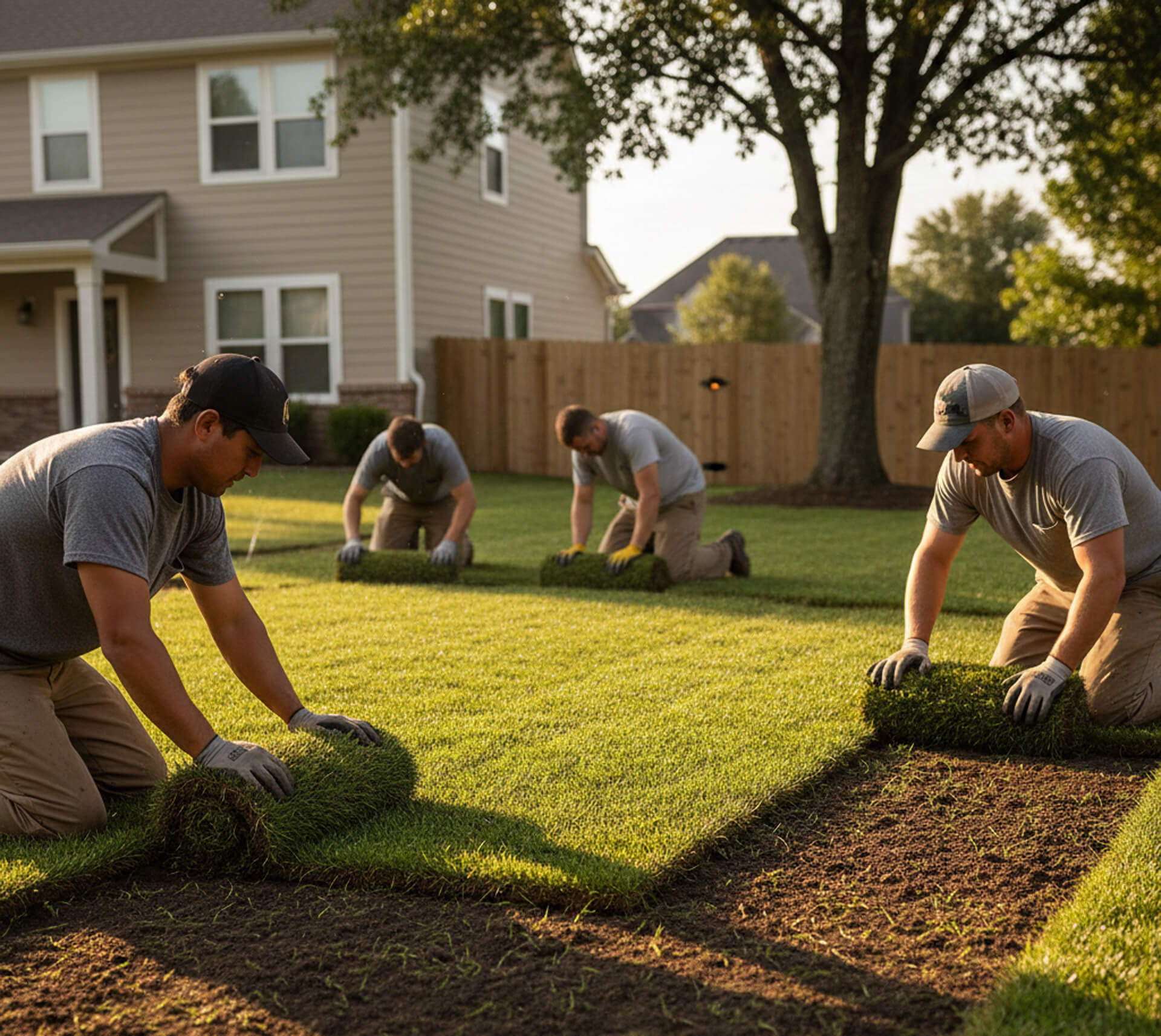
Installation pattern follows a staggered, brick-like offset between rows, with tight seams between individual pieces and edge pieces cut with a sharp blade rather than torn, producing a seamless finished appearance rather than visible gaps that widen as the sod settles.
Rolling immediately after installation, using a water-filled roller, ensures firm soil-to-root contact across the full sod area, which is essential for root establishment and one of the most commonly skipped steps in lower-quality installations.
Initial watering specification calls for daily irrigation sufficient to keep the sod and top inch of soil consistently moist for the first 10 to 14 days, gradually transitioning to a deeper, less frequent watering schedule as roots establish into the underlying soil over the following several weeks.
What Sod Installation Costs
Standard sod installation, including soil preparation, amendment, and cultivar-appropriate sod, typically costs 1.50 to 3.00 dollars per square foot depending on cultivar selection and the extent of soil amendment required. Properties requiring significant grading correction or extensive soil amendment due to construction debris or severe compaction typically run toward the higher end of this range.
Why Soil Preparation Determines Establishment Success
Sod installed over inadequately prepared, compacted clay soil frequently shows shallow, poorly developed root systems within the first growing season, making the lawn more vulnerable to heat stress, drought damage, and disease pressure than sod installed over properly amended, aerated soil. The soil preparation phase, invisible once sod is installed, is what ultimately determines whether the lawn thrives long-term or requires ongoing intervention to compensate for an inadequate foundation.
The team at Doddridge Landscaping installs sod across Austin with the soil preparation and cultivar accuracy our region's clay soil and climate genuinely require.

Planning sod installation for your Austin property? Reach out to Doddridge Landscaping today.
.svg)
.svg)
.svg)

.svg)